About 40% of Pennsylvania homes have radon levels above the EPA action level of 4 pCi/L, so it is no surprise that radon quotes vary widely across the state, especially in high risk areas like Lehigh County. We put this guide together to explain why radon quotes differ, what is typical in our region, and how you can tell if a price makes sense for your home.
Key Takeaways
| Question | Short Answer |
|---|---|
| Why do radon quotes vary so much in Pennsylvania? | Quotes change based on your location, geology, home design, and system complexity. In high risk areas like Germansville, local guides such as the Radon Mitigation Cost in Germansville 2026 Price Guide show typical price bands and scenarios. |
| What is a normal radon mitigation quote in Lehigh County? | Most homeowners spend between $1,200 and $2,500, similar to figures noted in regional overviews like Lehigh County radon services. |
| Do quotes differ between towns like Bethlehem, Allentown, and Germansville? | Yes, readings and house styles vary by town, so quotes shift too. Local pages like Bethlehem radon mitigation and Allentown radon testing highlight those differences. |
| How much should I budget for radon testing before I get mitigation quotes? | DIY kits usually cost $15–$30, while professional testing tends to run $150–$300, as outlined on our Germansville radon testing page. |
| Is the Lehigh Valley really one of the highest radon regions? | Yes, Germansville and surrounding towns sit on the Reading Prong, a geology that drives some of Pennsylvania’s highest readings, which we explain in depth on our Germansville radon levels, EPA Zone 1 overview. |
| Can I get emergency help if my levels test very high? | In rare urgent situations, some homeowners turn to services like our emergency radon response in Germansville to get rapid testing and mitigation planning. |
| Where can I find a full list of services in my town? | If you live near Germansville, our Complete Guide to Radon Mitigation in Germansville is a good starting point for understanding options and costs. |
1. Why Radon Quotes Vary So Much Across Pennsylvania
When homeowners compare radon quotes in Pennsylvania, they quickly notice a wide price spread, even between similar sized homes. We see this every day in the Lehigh Valley, where geology, construction, and existing conditions all pull quotes up or down.
First, your local geology matters, and areas on the Reading Prong like Germansville, New Tripoli, Bethlehem, and Allentown often start with higher baseline radon levels. Second, the design of your home, slab construction, crawl spaces, and additions can require more complex system layouts, which increases material and labor costs.
Third, quotes often reflect the type of system recommended, such as a basic sub slab depressurization setup compared to a combined slab plus crawl space solution. Finally, contractor experience, warranties, and included post mitigation testing affect price, which is why we always recommend comparing what is included, not just the bottom line number.
2. Typical Radon Mitigation Costs In Germansville And Lehigh County
In Germansville and much of Lehigh County, we usually see professional radon mitigation quotes fall between $1,200 and $2,500. Our own 2026 pricing breakdown for Germansville shows a local average in the $1,400 to $2,200 range for many standard homes.
Here is how those numbers often break down in our area:
- Basic sub slab depressurization: roughly $1,000 to $1,500
- Standard installation (most common): around $1,500 to $2,000
- Complex installation (larger or tricky layouts): roughly $2,000 to $3,500
- Crawl space ventilation systems: often $1,500 to $3,500
These ranges line up closely with statewide guidance, where permanent radon mitigation systems in Pennsylvania commonly fall around the low to mid four figure mark. Within that band, the specific quote you receive reflects the details of your property and the mitigation design your contractor recommends.
3. How Home Type And System Design Change Your Quote
Two homes on the same street in Pennsylvania can receive very different radon quotes because their structures and finishes are not identical. We see quote differences when one home has a simple basement slab, while the neighbor has a combination of slab, crawl space, and additions.
Some of the main design factors that affect your quote include:
- Full basement vs slab on grade vs crawl space
- Presence of finished spaces that limit access to slab areas
- Existing drain tile or sump pits that can be integrated into the system
- Required discharge locations and vent routing for best performance and aesthetics
A basic sub slab depressurization system is usually the most budget friendly approach, but it only works when there is good access to the soil gas under the slab. When we must manage multiple foundation types or install more extensive piping runs, labor, materials, and sometimes fan specifications change, which is reflected in the quote.
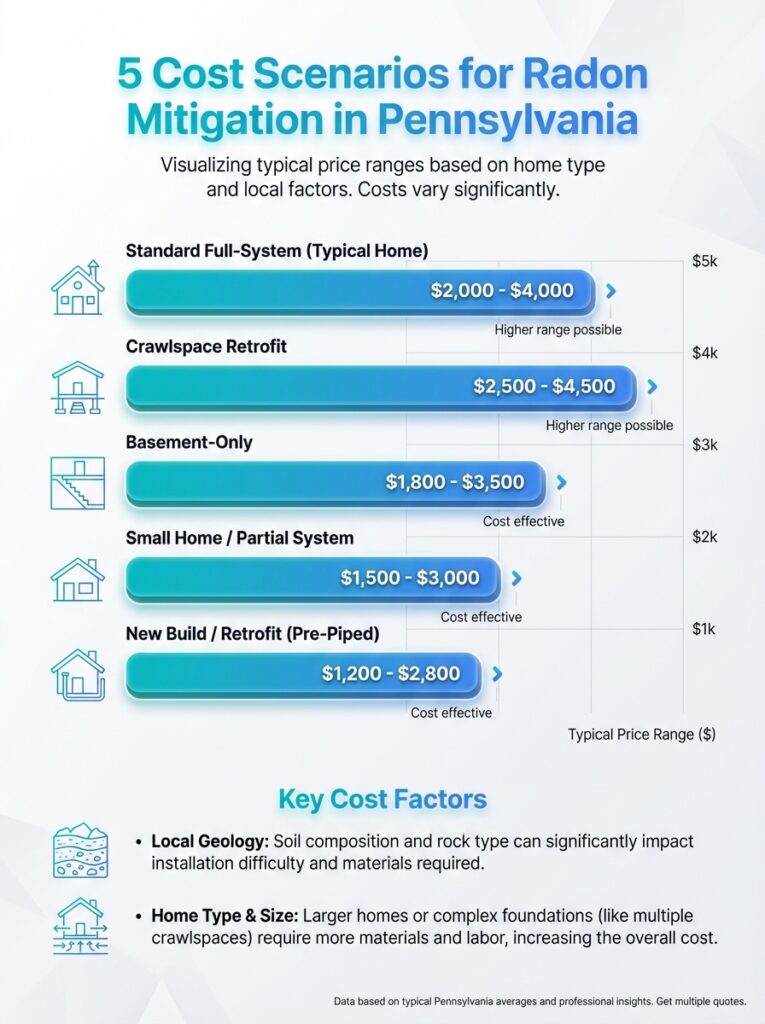
This infographic breaks down five potential costs for radon mitigation in Pennsylvania, helping homeowners compare options. See which scenario fits your budget and home health priorities.
Did You Know?
Permanent radon mitigation systems typically cost between $800 and $1,200 in Pennsylvania, although homes in high-risk geologies or with complex foundations may see quotes above this range.
4. Comparing Quotes: Germansville, New Tripoli, And Slatedale
Within a small area of Lehigh County, radon quotes still vary between towns like Germansville, New Tripoli, and Slatedale. This is partly due to slightly different geology layers and partly due to the typical home styles in each community.
| Town / Area | Typical Mitigation Quote Range | Notes |
|---|---|---|
| Germansville | $1,200–$2,500 | EPA Zone 1, Reading Prong geology, high baseline radon levels |
| New Tripoli | Approx. $1,100–$1,800 | Many homes need standard sub slab systems, some crawl spaces |
| Slatedale | $1,200–$2,500 | Martinsburg shale, elevated risk, mix of basements and slabs |
In practice, a basic, open basement in any of these towns usually ends up near the lower end of the range. More complex layouts, or homes where we must address both slab and crawl space areas, tend to land closer to the top of the band.
5. Why Testing Costs Matter Before You Request Quotes
Radon quotes in Pennsylvania usually start with accurate testing, because your contractor needs reliable readings to design a sensible system. In our area, homeowners often choose between DIY test kits and professional testing, and both options affect your upfront budget.
Across the state, radon test kits often cost about $20–$30, and locally we usually see them priced in the $15 to $30 band. Professional testing in towns like Allentown or Germansville typically runs between $150 and $300, which includes equipment placement, retrieval, and reporting.
- DIY short term kit: lower cost, but you must follow instructions carefully
- Professional short or long term test: more convenient, and you receive expert interpretation
We encourage homeowners in high risk zones to view testing as part of the total cost of addressing radon, not a separate or optional step. Accurate numbers help ensure that mitigation quotes are tailored, realistic, and more likely to reach your target levels once the system is installed.
6. Statewide vs Local Numbers: Pennsylvania Compared To The Lehigh Valley
Statewide, about 40% of Pennsylvania homes test at or above the EPA action level, but our Lehigh Valley service area often runs higher than that. Germansville, Bethlehem, and nearby towns on the Reading Prong rank among the stronger radon regions within a state that already has widespread radon concerns.
From a quoting perspective, this means two things. First, more homes in our region end up needing mitigation, so there is a more mature local market with experienced contractors and established pricing bands.
Second, higher starting radon levels may lead to slightly different system configurations or fan selections, which can influence the final quote. Even so, many homes still fall into the common $1,200 to $2,500 range, which matches what we see in general Pennsylvania guidance for full mitigation systems.
7. Bethlehem And Allentown: High Radon, Different Homes, Different Quotes
Bethlehem and Allentown both sit in high risk radon zones, but the housing stock in each city is not identical, and that affects quotes. Bethlehem’s connection to the Reading Prong contributes to significant radon readings, while Allentown combines older urban homes with newer suburban construction.
In practical terms, quotes for a rowhome basement in Allentown may differ from a larger single family structure in Bethlehem, even if initial radon test numbers are similar. Rowhomes can sometimes share walls and foundation elements, while suburban Bethlehem homes might have more exterior run options but longer pipe runs.
Across both cities, professional testing usually precedes a detailed mitigation quote, commonly in the $150 to $300 range. Once test results are in, many homes still fall into the same mid four figure mitigation cost band that we see throughout eastern Pennsylvania.
Did You Know?
Roughly all 67 Pennsylvania counties have detectable radon exposure, and the Lehigh Valley is among the highest globally for radon levels measured in homes.
8. Timing, Seasonality, And How They Affect Quotes
When homeowners across Pennsylvania start thinking about radon testing and quotes, seasonality often comes into play. Radon testing is commonly done in colder months, when homes are closed up and indoor radon levels are more concentrated.
This seasonal pattern can affect when you pay for testing and when you receive mitigation quotes. During January, which is recognized as National Radon Action Month, many Pennsylvania residents schedule tests and follow up quotes at the same time.
Contractors sometimes see heavier demand in these windows, which can influence scheduling rather than base pricing. From our side, we encourage homeowners to plan ahead, use the winter season for accurate testing, and then schedule mitigation at a time that fits both your budget and calendar.
9. What To Look For In A Radon Quote In Pennsylvania
When radon quotes vary across Pennsylvania, it helps to know what to compare beyond the price itself. We always recommend that homeowners request itemized quotes that clearly explain what is and is not included.
Some important items to review include:
- Type of mitigation system proposed (sub slab, crawl space, combination)
- Fan model and estimated energy use
- Number and length of suction points and vent runs
- Whether electrical work is included or separate
- Post mitigation testing and any follow up visits
- Warranty length and what it covers
In high risk areas like Germansville, Slatedale, or New Tripoli, we find that clear communication around these details helps homeowners choose quotes that offer both fair pricing and durable performance. A lower quote that excludes testing or follow up can end up costing more later if additional adjustments are needed.
10. Budgeting For Radon In Real Life: Test, Quote, Install, Retest
For Pennsylvania homeowners, especially in the Lehigh Valley, the total cost of dealing with radon usually follows a simple sequence. First, you pay for testing, then you collect quotes, approve an installation, and finally retest to verify results.
- Testing: $15–$30 for a DIY kit or $150–$300 for professional service
- Mitigation quote and installation: most often $1,200–$2,500 locally, depending on system design
- Post mitigation test: sometimes included in the quote, or similar cost to your initial test
When we work with homeowners, we aim to provide clear expectations at each step, so there are no surprise add ons midway through the project. Knowing these approximate ranges ahead of time helps you plan, especially if you are in the middle of a home purchase or preparing a property for sale.
Conclusion
Radon quotes vary across Pennsylvania because geology, home design, system type, and service details all play a role, and high risk regions like the Lehigh Valley bring those differences into sharp focus. Even so, most homeowners who test, compare detailed quotes, and choose a well designed system end up in a fairly predictable range for both testing and mitigation.
From our perspective, the most important step is to start with accurate testing, then work with experienced, properly certified professionals to design a system that fits your specific home. If you live in Germansville, New Tripoli, Slatedale, Bethlehem, Allentown, or anywhere else in Pennsylvania, understanding how quotes are built helps you budget confidently and choose the right solution for your property.