Radon is a serious issue across Pennsylvania, with about 40% of homes testing above the EPA action level of 4.0 pCi/L, so many families are asking whether the cost of radon mitigation can be written off on their taxes.
As radon professionals working every day with homeowners in Lehigh County and beyond, we want to walk you through how the tax rules actually work, what costs to expect, and how to plan financially when you need a mitigation system in Pennsylvania.
Key Takeaways
| Question | Short Answer |
|---|---|
| Is radon mitigation tax deductible in Pennsylvania? | On the Pennsylvania state income tax return, radon mitigation is generally not |
| Can radon mitigation be a federal medical expense? | In some situations, homeowners discuss treating mitigation as a medical expense at the federal level, but this depends on IRS rules and personal circumstances. Always confirm with a tax professional. |
| How much does mitigation usually cost in PA? | Typical professionally installed systems in our area often fall between $800 and $1,200, with some Lehigh County projects ranging from about $895 to $2,500 depending on the home. You can see a local pricing breakdown in our Lehigh County radon services guide. |
| Are there free or low‑cost ways to start? | Yes, radon test kits in Pennsylvania usually cost around $20–$30, and at times the state and partners offer free kits. Our Germansville radon testing page explains how professional testing fits into the process. |
| Does high radon affect home value and closings? | Yes, radon is a common negotiating point in Pennsylvania real estate. Our emergency radon services guide for Germansville real estate shows how fast mitigation can keep a sale on track. |
| Where can I learn more about local radon risk? | Lehigh County sits in EPA Zone 1, one of the highest risk categories. Our complete Germansville mitigation guide explains why our region sees some of Pennsylvania’s highest readings. |
| Who regulates radon work in PA? | The Pennsylvania Department of Environmental Protection oversees radon programs statewide. For a county‑wide perspective, see our Lehigh County mitigation overview. |
1. How Radon Mitigation Costs Fit Into Your Pennsylvania Tax Picture
Most homeowners first ask us, “Can I write this off on my taxes?” when they see an estimate for radon mitigation.
In Pennsylvania, the short answer at the state level is usually no, but the full financial picture is more nuanced and worth understanding.
From our experience in Lehigh County, a typical mitigation project can include:
- Initial system evaluation, often around $225
- Installation of a sub slab depressurization or similar system, usually starting around $895 in our local data
- Fan replacement down the road, often about $350
These numbers line up with statewide guidance that “permanent radon mitigation systems typically cost between $800 and $1,200,” although complex homes can be higher.
Because you are investing real money into your home, it is natural to ask if the cost is tax deductible, either as a medical expense, a home improvement, or an energy or safety upgrade.
From a practical standpoint, we encourage homeowners to separate two questions:
- How do I pay for the system today?
- Is there any potential tax or long‑term financial benefit from this work?
The rest of this guide focuses on that second question, while still grounding every answer in real costs and options we see across Pennsylvania.
2. Pennsylvania State Tax Rules: Why Radon Mitigation Usually Is Not Deductible
Pennsylvania’s personal income tax system works very differently from the federal system when it comes to deductions.
The Department of Revenue states that PA does not allow most federal itemized deductions, and that medical expenses are generally not deductible on the Pennsylvania return.
In fact, the state allows only a few deductions, such as certain Medical Savings Accounts, Health Savings Accounts, and specific 529‑related education deductions.
Radon mitigation costs do not fall into these categories in any direct way.
| Type of Expense | Typically Deductible on PA Return? |
|---|---|
| Radon testing or mitigation work on your home | No (treated as personal household expense) |
| General medical or dental expenses | No (not allowed as a state‑level medical deduction) |
| Contributions to qualifying HSAs or MSAs | Sometimes, if they meet PA’s specific rules |
| Most federal itemized deductions | No (Pennsylvania does not adopt them) |
Because of this structure, homeowners should assume that radon mitigation is not tax deductible on their Pennsylvania state income tax return, unless a tax professional gives very specific advice based on a unique situation.
Our role as radon contractors is to be clear about that up front, so you are not planning around savings that are unlikely to materialize at the state level.
Even when a radon system is necessary because your test results are high, Pennsylvania still treats that spending as a personal housing decision rather than a deductible medical cost.
That is why many of our clients look instead at financing options, real estate negotiation strategies, and federal‑level possibilities, which we cover next.
3. Federal Tax Considerations: Where Radon Mitigation Might Fit In
While Pennsylvania’s state rules are fairly rigid, federal tax rules give a little more room for discussion, especially around medical expenses.
We are not tax preparers, so we always advise clients to speak with a CPA or enrolled agent if they want to explore federal deductions in detail.
At the federal level, some homeowners ask whether radon mitigation can be considered a medical expense if a doctor recommends a healthier home environment or if there are existing respiratory concerns.
Others look at whether mitigation might be treated as a capital improvement that could factor into home basis calculations when they eventually sell.
We can help on the documentation side by providing:
- Detailed invoices that break out testing, labor, and materials
- System design notes and installation dates
- Post‑mitigation test results, which show that the work was completed and effective
Those records give your tax advisor what they need if you explore any potential federal treatment of the expense.
From a planning perspective, we encourage homeowners to view any federal tax benefit as a possible bonus, not a guarantee, so the decision to mitigate is based on budget and peace of mind rather than uncertain tax outcomes.
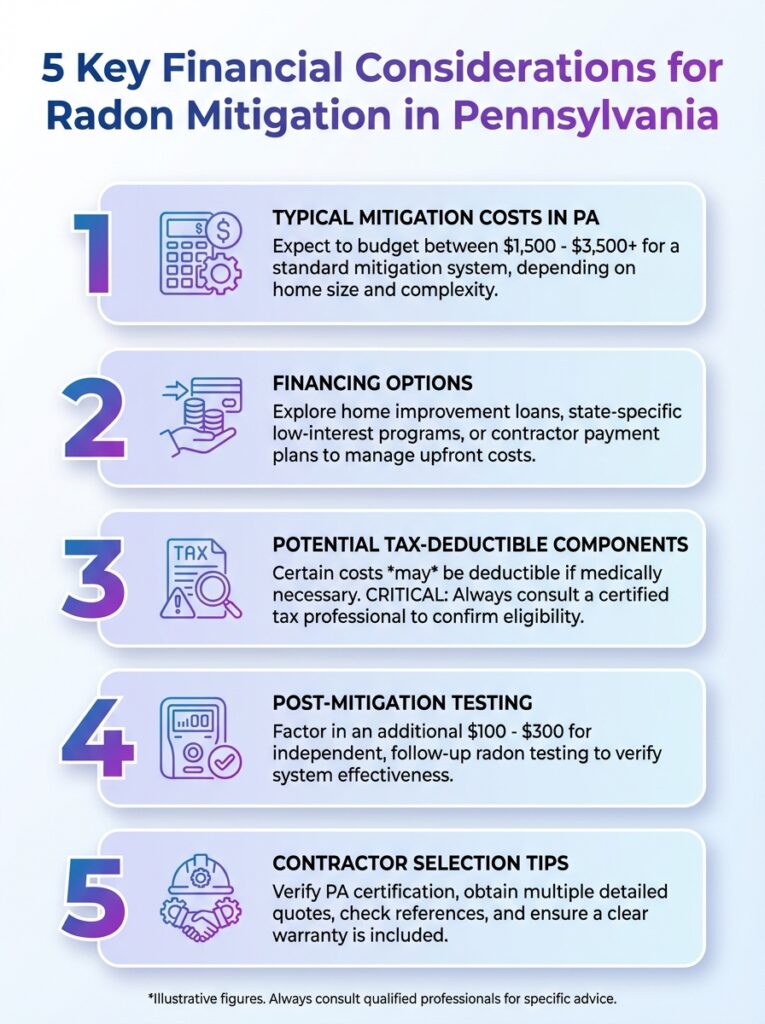
This infographic breaks down five financial considerations for radon mitigation in Pennsylvania. It highlights tax deduction questions, cost ranges, and planning tips.
Did You Know?
73% of Pennsylvania counties are EPA Zone 1, the highest radon risk category, which means most areas of the state face elevated baseline risk and a higher likelihood of needing mitigation.
4. Typical Radon Mitigation Costs in Pennsylvania and How They Compare
When we talk about whether mitigation is tax deductible, it helps to know what you are actually spending.
Across Pennsylvania, and especially in Lehigh County, we routinely see system costs that match the PA DEP guideline of about $800 to $1,200 for a permanent system, with some homes higher due to layout or construction details.
Sample Cost Breakdown From Our Local Data
| Service | Typical Local Price |
|---|---|
| System evaluation and design | $225 |
| Standard mitigation installation (single suction point, standard fan) | From around $895 in simple Germansville‑area homes |
| Complex system (large footprint, multiple suction points, extensive piping) | Up to $2,500 or more in some Lehigh County projects |
| Future fan replacement | About $350 |
While these costs are significant, they are often comparable to other major home projects like roofing repairs or HVAC upgrades.
Because PA does not usually let you deduct these amounts on the state return, we help clients plan using:
- Clear estimates upfront before any work begins
- Flexible financing, sometimes including 0% APR offers for qualified homeowners
- System designs that solve the problem without unnecessary add‑ons
When we walk you through options, we also help you weigh the immediate cost against very real long‑term benefits, like smoother real estate transactions and fewer surprises when you sell.
For most families, those practical benefits matter more than whether they can shave a small amount off a future tax bill.
5. Testing Costs: The First Step Before Any Tax or Mitigation Decisions
Before anyone can talk seriously about mitigation or tax questions, the first step is always testing.
In Pennsylvania, basic radon test kits usually cost around $20–$30, and the state often partners with organizations to provide free kits during awareness campaigns while supplies last.
Professional testing, like the work we provide in Allentown, Bethlehem, Germansville, and surrounding areas, gives you a clear snapshot of your home’s radon levels.
Because roughly 61% of Pennsylvania homes tested show elevated radon above 4.0 pCi/L in some surveys, testing is not a formality in our state, it is a key decision‑making tool.
Why Testing Matters Financially
Testing affects your wallet in several ways:
- It tells you whether mitigation is needed at all.
- It gives a baseline that helps size and design the system correctly.
- It documents conditions before and after mitigation for your records and for future buyers.
From a tax perspective, test kit costs are modest and usually treated as personal expenses, not deductions.
From a practical perspective, though, that small investment can save you from guessing about a much larger mitigation decision.
6. Long‑Term Maintenance, Retesting, and Ongoing Costs
Once a mitigation system is in place, it does not require constant attention, but it is not completely set‑and‑forget either.
PA DEP guidance recommends that homes with radon mitigation be retested approximately every two years to confirm that levels remain within the target range.
Retesting may involve low‑cost kits or professional devices, depending on your preference.
Over the lifetime of the system, you can expect:
- Periodic retesting costs every 2 years
- Electricity to run the fan (typically modest, similar to a bathroom fan)
- Eventual fan replacement, often around $350 in our region
None of these ongoing expenses are typically deductible on the PA state return, but they are important to budget for as part of owning a mitigation system.
We often schedule a follow‑up calendar with our customers so they remember to retest and so fan performance does not quietly decline over time.
Did You Know?
Even after mitigation is installed, Pennsylvania guidance recommends testing every two years to confirm that radon levels remain within the desired range and that the system is still working as intended.
7. How Radon Mitigation Affects Home Value and Real Estate Deals in Pennsylvania
In our day‑to‑day work, the most immediate financial impact of radon is often on real estate transactions, not taxes.
Sellers who discover high radon during inspection are frequently asked to install mitigation, provide a credit, or renegotiate price.
We handle many emergency radon jobs for closings in Germansville and surrounding communities, where timelines are tight and documentation has to be precise.
A professionally installed system with clear test results can:
- Prevent deals from falling apart over radon concerns
- Reassure buyers that the issue has been addressed thoughtfully
- Reduce the need to discount the home price by more than the actual cost of mitigation
When you look at the expense of mitigation, it often helps to think in terms of:
“Will this system pay for itself by protecting my asking price and keeping my closing on track?”
In many transactions we see, the answer is yes, even without any tax deduction.
8. Understanding Why Radon Is So Common in Pennsylvania’s Tax and Housing Conversations
Radon is a financial topic in Pennsylvania simply because it is so common here.
Our state has a unique geology, including the Reading Prong and uranium‑rich bedrock, that drives high indoor radon levels across large areas.
That is why 73% of Pennsylvania counties are in EPA Zone 1, and why so many of our local communities, from New Tripoli to Bethlehem, appear in high‑risk maps.
For homeowners, this means:
- Testing is routine and strongly encouraged in most parts of the state.
- Mitigation is a common home upgrade, similar to adding a sump pump or dehumidifier.
- Buyers, sellers, and agents often expect to see radon addressed during a sale.
Because radon is so woven into Pennsylvania housing, tax questions naturally follow, but most of the financial impact still lands in day‑to‑day budgeting rather than on tax forms.
9. Comparing Radon Mitigation To Other Non‑Deductible Home Improvements
One way we help clients frame radon spending is by comparing it to other common home projects that are also not tax deductible in Pennsylvania.
Think of:
- New roof or major roof repair
- Furnace or central air replacement
- Basement waterproofing or sump pump installation
These projects, like radon mitigation, are typically treated as personal home expenses that do not reduce your state income taxes.
What makes radon unique is:
- The widespread nature of the risk in Pennsylvania
- The role of mitigation in real estate negotiations
- The need for periodic retesting after installation
From a planning perspective, though, you can budget for radon in much the same way that you budget for other major home systems, knowing that state tax deductions are unlikely.
10. Practical Steps To Take If You Are Weighing Taxes and Radon Mitigation
If you are trying to decide how radon mitigation fits into your financial life in Pennsylvania, a simple step‑by‑step approach can help.
Here is a process we often walk through with homeowners:
- Test your home using either a low‑cost kit or professional testing, especially if you live in a Zone 1 county.
- Review the results and decide whether mitigation is necessary based on EPA and PA DEP guidance.
- Get a detailed quote that breaks out evaluation, installation, and any optional upgrades.
- Discuss financing and timing, especially if you are in the middle of a real estate transaction.
- Talk with a tax professional about any possible federal treatment of the expense, while assuming that PA state deductibility is unlikely.
- Keep all documentation, including invoices and before‑and‑after test results.
- Plan for retesting and eventual fan replacement as part of your long‑term home maintenance budget.
This approach keeps you grounded in facts, not assumptions, and helps you make a clear, confident decision about testing, mitigation, and any tax questions.
As contractors, our job is to support you with accurate readings, thoughtful system design, and clear documentation so that whatever choice you make is well informed.
Conclusion
Radon mitigation is a real and sometimes urgent expense for many Pennsylvania homeowners, especially in high‑risk areas like Lehigh County.
While it is natural to hope that those costs might be fully tax deductible, Pennsylvania’s state tax rules rarely allow that, and any potential federal treatment depends on individual circumstances and professional tax advice.
In practice, we encourage our clients to view mitigation as a straightforward home investment:
- Test first so you know exactly where you stand.
- Budget based on realistic cost ranges, usually around $800 to $1,200 for most systems.
- Use financing, documentation, and retesting to manage the expense over time.
- Talk with a tax professional if you want to explore whether any part of the cost fits into your federal tax picture.
If you are in Pennsylvania and trying to decide what to do next, we are always ready to walk through your test results, explain your options, and help you make a clear, financially sound plan for radon mitigation in your home.