Radon affects an estimated 40% of Pennsylvania homes above the common 4.0 pCi/L guideline, so understanding what drives radon mitigation cost factors in Lehigh County helps you plan with confidence and avoid surprises during your project.
We work across Lehigh County every day, and we see how geology, home design, and installation choices shape real-world pricing for local families.
Key Takeaways
| Question | Short Answer |
|---|---|
| How much does radon mitigation typically cost in Lehigh County? | Most single-family systems in our area fall around $1,200–$2,500, with simple jobs closer to $1,000 and complex installs up to $3,500. You can see a detailed Germansville price breakdown here: Germansville radon mitigation cost guide. |
| Which factors affect my radon mitigation cost the most? | Key drivers are home size, foundation type (slab, basement, crawl space), the system design needed, and how easy it is to route piping and power. For county-wide context, visit Radon mitigation services across Lehigh County. |
| Is radon testing an extra cost before mitigation? | Yes, testing is a separate line item. DIY kits often run $15–$30, while professional testing is usually $150–$300 in areas like Allentown and Germansville, as outlined in our Allentown radon testing guide. |
| Are Lehigh County costs higher than the rest of Pennsylvania? | Our region sits in EPA Zone 1, so mitigation demand is high but prices stay competitive. Typical Lehigh County installs align closely with the statewide ranges explained on our Lehigh County radon services page. |
| Does my town (Allentown, Bethlehem, Germansville, etc.) change the price? | Labor and materials are similar across the county, but geology and home styles vary. You can see local examples in Bethlehem mitigation pricing and Germansville mitigation details. |
| What if I just need testing in Germansville or nearby? | Professional testing in Germansville typically runs $150–$300, with options explained on our Germansville radon testing services page. |
1. Why Radon Mitigation Costs Matter So Much In Lehigh County
Lehigh County sits in EPA Zone 1, the highest risk category, and local data shows that around 64% of homes can exceed the 4.0 pCi/L action guideline at some point.
That combination of geology and housing stock means many homeowners will eventually face mitigation decisions, so understanding cost factors upfront helps you budget and choose the right system instead of the cheapest option on paper.
We see several consistent price bands locally: a typical radon mitigation system across Lehigh County often falls between $1,200 and $2,500, with some straightforward homes coming in a bit lower.
More complex properties, especially those with crawl spaces or multiple foundation types, can land in the $2,000–$3,500 range once all materials and labor are included.
From our perspective as local mitigators, we always recommend starting with accurate testing, then designing a system that targets your actual levels, layout, and long-term plans for the home.
This approach often prevents unnecessary add-ons and helps keep your project within a realistic and fair budget.
2. Typical Radon Mitigation Price Ranges In Lehigh County
Across Lehigh County, we see strong alignment with both Pennsylvania and national pricing, but with a few local twists tied to the Reading Prong geology.
Most single-family homeowners we serve fall into these general price brackets for a full mitigation system installation.
| System Type / Scenario | Typical Price Range | Where We See It |
|---|---|---|
| Basic sub-slab depressurization | $1,000–$1,500 | Smaller homes, straightforward basements or slabs |
| Standard installation | $1,500–$2,000 | Average Lehigh County single-family homes |
| Complex installation | $2,000–$3,500 | Multiple foundations, complex routing, or high initial levels |
| Crawl space ventilation or sealing | $1,500–$3,500 | Homes in outlying areas with exposed crawl spaces |
These figures come directly from our Germansville pricing guide, which reflects real projects in northern Lehigh County.
We also regularly see a typical installed mitigation system around $1,100–$1,600 in communities like Allentown and Bethlehem, depending on structure and finish quality.
For homeowners budgeting a future project, we suggest planning around the mid-range numbers, then letting an in-person assessment refine your estimate.
This way you avoid under-budgeting for a complex job or overestimating a relatively simple one.
3. Home Size And Layout: Why Square Footage Is Only Part Of The Story
Many people assume radon mitigation costs scale only with square footage, but in Lehigh County we see layout and construction details matter more than pure size.
A smaller split-level with multiple foundation sections can cost more to mitigate than a larger, simple ranch with a single basement slab.
Key layout drivers that affect your price include:
- Number of foundation sections or slabs to be tied into one system
- Distance from suction point to ideal fan and discharge location
- Ceiling heights and finished areas that limit routing options
- Accessibility of mechanical spaces and electrical panel
Larger homes often need more piping and heavier-duty fans, which adds materials and labor, but we can still contain costs when the layout is straightforward.
The most expensive projects we see are not necessarily the largest homes, but the ones that require creative routing through finished spaces, additions, or mixed basement and crawl space combinations.
From a cost perspective, the best thing you can do is share any addition history, old blueprints, or known foundation changes during your estimate.
This helps us design a system that balances effectiveness, appearance, and cost without guesswork.
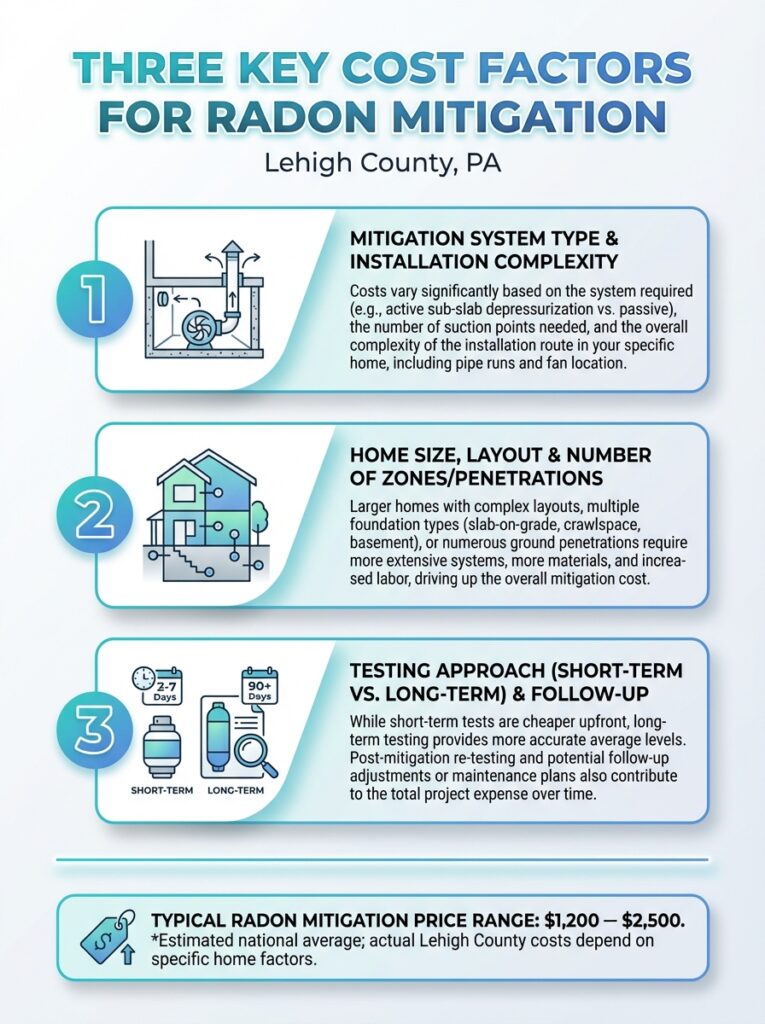
An infographic highlighting three key cost factors for radon mitigation in Lehigh County. It helps homeowners estimate expenses by system type, home size, and installation complexity.
4. Foundation Type: Basements, Slabs, And Crawl Spaces In Lehigh County
Your foundation type is one of the biggest radon mitigation cost factors in Lehigh County, because it determines the system style we must use and how much preparation is needed.
Across our service area we regularly encounter three main situations, each with distinct pricing implications.
Basements and Slabs
Full basements or slab-on-grade homes are ideal candidates for sub-slab depressurization</strong}, the most common and cost-effective mitigation method.
These jobs often fall into the $1,000–$2,000 band as long as we can locate a good suction point and route the discharge with minimal obstructions.
Crawl Spaces
Crawl spaces are common in more rural parts of Lehigh County and often cost more to treat properly.
We may need to install heavy-duty vapor barriers and specialized ventilation, which is why crawl space radon work frequently lands in the $1,500–$3,500 range.
Mixed Foundations
Many Lehigh Valley homes, especially older properties with additions, combine basements, slabs, and crawl spaces.
In these cases we often need multiple suction points or a hybrid system, and that complexity can push costs toward the upper end of typical ranges.
Did You Know?
In Allentown/Lehigh County, local radon mitigation quotes commonly fall in the $895–$1,600 range, which means many homeowners can solve high radon with a project that costs less than a typical major appliance upgrade.
5. System Type And Components: Where Your Money Actually Goes
When we talk about “a radon system” in Lehigh County, we are usually referring to a sub-slab or sub-membrane depressurization system custom designed for your home.
Within that broad category, individual components and add-ons can significantly influence your final price.
Core Components
A typical installation includes a radon fan, PVC piping, roof or sidewall discharge, caulking and sealing, and electrical work to power the fan.
Higher capacity or specialty fans cost more upfront, but they may be necessary for larger or more resistant slabs common in parts of the county.
Optional Upgrades
Some homeowners choose visual system enhancements, such as painted piping, low-profile routing, or specific discharge locations to preserve curb appeal.
Others opt for upgraded monitoring devices or more robust exterior materials for long-term durability.
From our experience, spending a little more on proper fan sizing and smart routing usually adds more long-term value than cosmetic upgrades alone.
We always walk through these options during estimates so you understand what is essential and what is optional in your quote.
6. Testing Costs Before And After Mitigation
Testing is a separate but essential part of managing radon mitigation cost factors in Lehigh County, because it shapes your initial decision and verifies that your system is working.
There are two main cost paths here, DIY testing and professional testing.
DIY Testing Costs
DIY radon test kits are widely available and typically run $15–$30 in the Allentown and Germansville area.
These kits are an affordable way to get an initial snapshot and help you decide whether to call in a professional.
Professional Testing Costs
Professional radon testing in communities like Allentown, Bethlehem, and Germansville usually ranges from $150 to $300, depending on the device used and the complexity of the setup.
Continuous radon monitors used by professionals can cost the provider $1,500–$3,000, which is one reason expert testing carries a higher fee.
After mitigation, we always recommend a follow-up test to confirm that levels dropped to your target range for the way you use the home.
Some homeowners also budget for periodic re-testing every couple of years as a long-term check on system performance.
7. Local Geological Risk: EPA Zone 1 And The Reading Prong
You cannot talk about radon mitigation cost factors in Lehigh County without addressing geology, because our local rock formations directly affect both risk and demand for mitigation.
The county sits on the Reading Prong, a uranium-rich geological feature that contributes to consistently elevated radon potential.
This high baseline risk translates into more frequent testing, more mitigation projects, and a mature local market of contractors.
For homeowners, that usually means competitive pricing and a wide range of experience levels to choose from.
From a cost standpoint, our Zone 1 status does not automatically make each individual installation more expensive.
Instead, it increases the likelihood that you will eventually need to invest in a system, so budgeting ahead is simply prudent planning for Lehigh County homeowners.
Did You Know?
National radon mitigation costs range from $700 to $4,000, with an average around $1,000, so Lehigh County’s typical $1,200–$2,500 project sits right in the middle of what homeowners across the country pay.
8. Ongoing Costs: Fan Power, Maintenance, And Re-Testing
When you evaluate radon mitigation cost factors in Lehigh County, it is important to think beyond the installation day and consider ongoing ownership costs.
Fortunately, those long-term costs are relatively modest compared to many other home systems.
The radon fan will use electricity around the clock, and typical annual operating costs in our area often fall under a few dollars per month, depending on fan size and local utility rates.
Most quality fans last many years, and when replacement is needed, it is usually a straightforward service compared to the initial install.
We also recommend budgeting for periodic re-testing, typically every couple of years, to confirm that your system continues to perform as intended.
Compared to the one-time install cost, these ongoing expenses are predictable and relatively low, which makes radon mitigation a manageable long-term commitment for most Lehigh County households.
9. Choosing A Contractor: Price Versus Value In Lehigh County
With multiple radon contractors serving Lehigh County, it can be tempting to choose solely on lowest price, but that can be risky.
From our experience, the best value comes from certified professionals who design systems specifically for your home, back their work with clear warranties, and perform or arrange proper post-mitigation testing.
When you compare quotes, look beyond the bottom line and consider:
- Certifications (such as PA DEP, NRPP, or similar credentials)
- Number of systems installed and years of local experience
- Warranty terms on both workmanship and equipment
- Inclusion of post-mitigation testing or clear testing guidance
We always encourage homeowners to ask questions about fan sizing, suction point placement, piping routes, and estimated radon reductions.
If a contractor cannot explain those details clearly, even a low price may not represent good value in the long term.
10. How To Budget And Plan Your Radon Mitigation Project
Once you understand the main radon mitigation cost factors in Lehigh County, you can build a realistic budget and timeline for your home.
We recommend taking a simple, step-by-step approach so you stay in control of both cost and quality.
- Start with testing. Use a DIY kit or schedule professional testing to get clear baseline numbers.
- Gather at least one detailed quote. Make sure it spells out system type, components, and any assumptions.
- Plan for contingencies. Set aside a small buffer in case we discover hidden obstacles during installation.
- Confirm warranty and testing. Ensure your quote includes or explains post-mitigation verification.
For many Lehigh County homeowners, the entire process from estimate to completed installation can be completed within a few days once you decide to move forward.
Our goal is always the same, to design a cost-effective system that fits your home, respects your budget, and delivers reliable long-term performance.
Conclusion
Radon mitigation cost factors in Lehigh County come down to a mix of geology, home design, foundation type, and the quality of the system you choose.
Most local projects fall between $1,200 and $2,500, with clear reasons when a home lands above or below that range.
By understanding how square footage, layout, crawl spaces, and system components affect your final price, you can ask better questions and compare quotes on more than just the bottom line.
If you would like a clear, no-pressure estimate tailored to your Lehigh County home, we are always ready to walk through your options and help you plan the right solution at a fair cost.