In Pennsylvania, about 40% of homes have radon levels above the EPA action level of 4 pCi/L, so buyers in our state ask about radon almost as often as they ask about the roof and furnace. If you are planning to sell or buy a home in PA, understanding how radon mitigation affects your property value and marketability is now a basic part of smart homeownership.
Key Takeaways
| Common Question | Short Answer |
|---|---|
| Does radon mitigation hurt my home value in PA? | No. Radon systems are widely treated as a normal home improvement, and, as we explain on our radon mitigation cost guide for Germansville, they are comparable to other mechanical upgrades. |
| Can mitigation make my home easier to sell? | Yes. In high‑risk Lehigh County areas, pre‑installed mitigation often removes a major buyer objection and can prevent last‑minute price negotiations. |
| How much does professional mitigation usually cost in PA? | Typical systems in our region run $1,200–$2,500, with basic sub‑slab systems starting closer to $1,000–$1,500 as detailed in our local pricing breakdown. |
| Is mitigation expected for homes in EPA Zone 1 areas of PA? | In communities like Germansville and Allentown that sit in EPA Zone 1, we see more buyers and agents treating mitigation as a standard line item, similar to having GFCI outlets or smoke detectors, as discussed in our EPA Zone 1 explainer. |
| Will buyers in PA ask for radon testing? | Almost always in Lehigh County. Our Allentown radon testing guide explains why local buyers routinely add radon contingencies to agreements. |
| Should I test and mitigate before listing? | If you are in a known high‑risk pocket like Germansville, Lynnport, New Tripoli, or Slatedale, pre‑listing action can position your home better, as we outline in our Lehigh County radon mitigation overview. |
| Where can I learn about local radon conditions? | We break down local readings and geology in detail on our Germansville radon levels guide, which helps sellers understand what buyers already see in public data. |
How Radon Mitigation Fits Into Home Value Conversations In Pennsylvania
We talk with buyers, sellers, and real estate agents across Lehigh County every week, and radon comes up in almost every transaction conversation. In our area, radon is not a rare surprise, it is a known factor that buyers expect to address.
Because so many Pennsylvania homes test above 4 pCi/L, mitigation is treated as a practical upgrade rather than a stigma. When your home already has a professional system, you are answering a question buyers will ask anyway.
Why PA Buyers Expect Radon To Be Addressed
Public maps and state data make it very clear that eastern PA is a high‑potential region for elevated radon. Many buyers come to showings already aware that Lehigh County is in EPA Radon Zone 1.
When a listing in Germansville, Allentown, or New Tripoli has no radon history and no system, buyers often budget for it or ask for a credit. If a neat, documented system is already in place, it usually feels like one less headache.
Radon Risk In Lehigh County And Why Buyers Care
Our local data in Germansville, Lynnport, Slatedale, and Allentown shows that elevated radon levels are common, not occasional. We have personally seen readings over 20 pCi/L in everyday family homes, which catches every buyer’s attention once they review the report.
Lehigh County sits on the Reading Prong and related formations, which are known across Pennsylvania for higher radon potential. Because of this, many lenders and inspectors strongly recommend testing during the purchase process.
EPA Zone 1: What It Means For Home Value
When a region is labeled EPA Zone 1, it signals that average indoor levels are predicted to be 4 pCi/L or higher. In practice, that pushes radon to the front of mind for real estate transactions in communities like Germansville.
For sellers, this classification is not a negative if you handle it directly. Buyers do not expect a PA home to have zero radon potential, but they do expect an honest test and a practical plan.
Typical Radon Mitigation Costs In PA And How They Compare To Home Prices
When we talk about whether radon mitigation can increase or protect home value in PA, cost is the first practical question. Across Pennsylvania, permanent mitigation systems often run between $800 and $1,200, and in Lehigh County our local averages are slightly higher because of house design and soil conditions.
In Germansville, our detailed cost guide shows a common range of $1,200–$2,500, with most standard installations landing around $1,500–$2,000. Compared to overall home prices, this is usually a relatively small investment that can influence buyer confidence far more than its dollar amount.
Example Cost Ranges From Our Local Work
- Sub‑slab depressurization (basic): about $1,000–$1,500 for straightforward basements.
- Standard mitigation system: about $1,500–$2,000, which covers most homes in our area.
- Complex or crawl space work: about $2,000–$3,500, especially where crawl space ventilation runs $1,500–$3,500.
When buyers see a clean system with documentation, many view it the same way they view a newer water heater or roof repair. The cost to install is real, but it is modest compared to the potential impact on negotiations if high radon shows up without a plan.
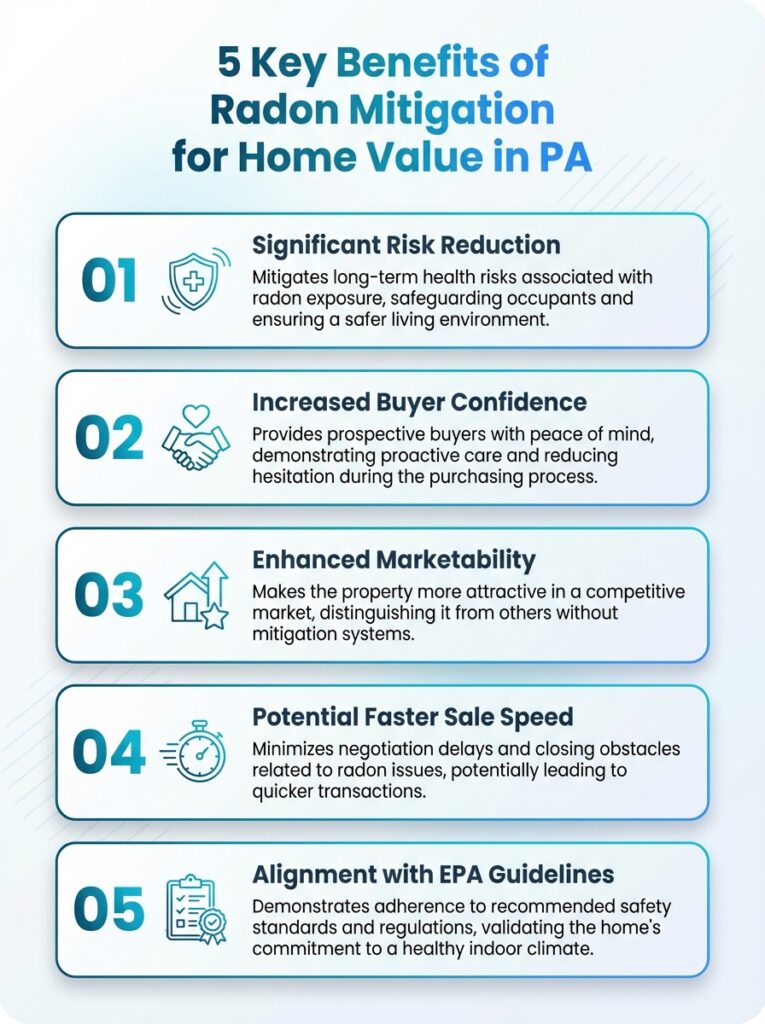
Discover how radon mitigation can boost your home’s value in PA with these five key benefits.
Did You Know?
Radon reduction systems can reduce indoor radon levels by up to 99%, which is one reason buyers and inspectors in PA often view a professionally installed system as a strong positive feature.
How Radon Mitigation Can Protect Or Improve Your Home’s Marketability In PA
In practical terms, the biggest value benefit of radon mitigation in PA is often smoother negotiations. When a test during a sale comes back high and there is no system, buyers usually respond with one of three requests: install a system, provide a credit, or lower the price.
We routinely see deals in Lehigh County where a pre‑installed system avoids last‑minute delays, contractor schedule issues, and emotional price discussions. That peace of mind can translate to stronger offers and fewer surprises for both sides.
Ways Mitigation Helps You In The Market
- Fewer buyer objections: Buyers already know PA has radon, so seeing a working system calms a major concern.
- Cleaner inspection reports: Many inspection summaries flag elevated radon as a primary issue if not already addressed.
- Stronger listing story: You can present your home as “radon tested, mitigation installed, and post‑mitigation levels verified.”
We cannot promise a specific dollar increase in appraisal value, but we can say from experience that removing a common objection almost always helps your position when offers come in.
Pennsylvania Laws, Disclosure Rules, And Buyer Expectations
In Pennsylvania, sellers must disclose any known radon test results on the standard Seller’s Property Disclosure Statement. That means if you already know you have elevated radon, you will need to state it, and buyers will expect it to be handled.
PA also requires radon testers and mitigators to be certified by the Department of Environmental Protection. When buyers see that a certified professional installed your system and completed follow‑up testing, it usually builds trust in your home’s overall maintenance history.
What Appears In A Typical PA Real Estate File
- Any past radon test reports you provide with the disclosure.
- Buyer’s own radon test results if they add a radon contingency.
- Mitigation installation invoices and post‑mitigation test results.
Handled well, these documents paint a picture of a home that has been cared for carefully, which often helps justify your asking price compared with similar local listings.
Did You Know?
Radon mitigation is not expected to hurt home value; national guidance for consumers notes that radon systems are widely accepted as a typical home improvement and do not reduce appraisal value.
Testing First: The Foundation Of Any Value Conversation
Before we talk about mitigation and value, we always start with accurate testing. In PA, basic radon test kits often cost about $20–$30, and professional testing is still relatively affordable compared with other home inspection items.
In Allentown, Germansville, and surrounding towns, we usually recommend short‑term professional tests during real estate transactions, followed by longer‑term monitoring if needed. Buyers feel more comfortable when they see clear, recent numbers rather than guesses.
Why Professional Testing Helps In A Sale
- Results are documented by a certified tester, which reassures buyers and lenders.
- We can explain exactly how long the device was in place and under what conditions.
- If levels are elevated, we can outline realistic mitigation options and expected outcomes.
From a home value perspective, good information helps you set fair expectations and respond confidently to buyer questions. It is much easier to negotiate around a clear report than speculation.
What A Professional Radon Mitigation System Looks Like To Buyers
When we design systems in Lehigh County homes, we focus on performance and appearance because both matter to buyers. A neat installation, clean exterior venting, and labeled components all contribute to a good first impression during showings and inspections.
Most systems we install are sub‑slab depressurization systems, which pull radon from beneath the slab and vent it safely above the roofline. To buyers, the visible parts usually include PVC piping, a radon fan, an indicator gauge, and sometimes a discreet exterior exhaust.
Features Buyers Appreciate
- Clear system label and contact information for future service.
- Pressure gauge or monitoring device that shows the system is operating.
- Post‑mitigation test report that documents reduced levels.
We also provide warranty coverage on our systems, and buyers often see that as one more sign that they can move in confidently without facing an immediate radon project.
Radon Mitigation And Appraisal: What We See In Practice
Appraisers in Pennsylvania typically treat radon mitigation like other mechanical improvements. They rarely assign a specific line‑item dollar value to a radon system, but they do consider the overall condition and marketability of the home.
In our experience working alongside local agents, a home with proven high radon and no mitigation can face more negotiation pressure than a similar home with a documented system. That difference may not appear as a separate field in the appraisal, but it often shows up in what buyers are ultimately willing to pay.
How Mitigation Influences Informal Value Perception
- Homes that are “radon ready” often feel more move‑in ready overall.
- Buyers comparing two similar properties may favor the one with a system already installed.
- Agents can present your home as proactively maintained, which helps during pricing discussions.
We are careful not to overstate radon’s role, but we consistently see that addressing it early removes a risk factor that can otherwise affect both time on market and final sale price.
Strategies For Sellers In High‑Radon Pockets Of PA
If you are selling in Germansville, Lynnport, New Tripoli, Slatedale, or elsewhere in Lehigh County, we suggest a simple, step‑by‑step plan. First, test before listing so you, your agent, and any future buyers are working from the same information.
If levels are elevated, talk with a certified mitigator about system design and realistic pricing. In our area, many sellers choose to install the system before listing so they can advertise “radon addressed” from day one.
Checklist For Maximizing Value When Radon Is Involved
- Order a current radon test and keep the written report.
- If needed, install a professional mitigation system and keep the invoice and warranty.
- Complete a post‑mitigation test and include the results in your disclosure packet.
- Ask your agent to feature the system in listing remarks so buyers see it as a benefit.
Handled this way, radon becomes another item you have already taken care of for the next owner, which is exactly what most buyers hope to see.
How We Support Pennsylvania Homeowners With Radon And Home Value Questions
We know radon can feel intimidating when you first learn about it, especially if you are thinking about selling a home. Our role is to simplify the process, give you clear numbers, and design systems that work reliably without distracting from your home’s appearance.
We work around your schedule, explain every recommendation in plain language, and treat each house as if we were preparing it for our own families. Whether you are months away from listing or under contract right now, we are happy to walk you through practical options.
Conclusion
Radon mitigation on its own will not magically raise a home’s appraised value by a set dollar amount in Pennsylvania, but it can strongly protect and support your home’s value in real‑world negotiations. In high‑risk regions like Lehigh County, many buyers now expect radon to be tested and addressed, and they respond more positively when that work is already complete.
By investing in accurate testing, professional mitigation where needed, and clear documentation, you turn a potential objection into a selling point. If you are unsure where to start, we are always ready to provide a complimentary consultation and help you choose the most sensible path for your home and your goals.