About 40% of Pennsylvania homes have radon levels above the EPA action level of 4 pCi/L, so many families here end up facing radon mitigation costs and looking for practical financing options. In this guide, we walk through what radon mitigation really costs in Pennsylvania and how you can spread those costs out with financing that fits your budget.
Key Takeaways
| Question | Answer |
|---|---|
| How much does radon mitigation cost in Pennsylvania? | In many PA communities, including Lehigh County, typical professional radon mitigation systems run from $1,200 to $2,500, with basic systems sometimes starting around $1,000 and complex installations reaching $3,500+. For a detailed 2026 breakdown, see our Radon Mitigation Cost in Germansville price guide. |
| Do companies offer 0% APR or monthly payments? | Yes, in our area we offer 0% APR financing with payments as low as about $75 per month for many standard systems, which lets you address radon issues without paying everything at once. |
| Is mitigation really necessary in my part of PA? | All 67 Pennsylvania counties have documented radon exposure, and areas like Germansville and Lynn Township sit in EPA Zone 1, the highest risk classification. Local mapping is explained on our Germansville radon levels overview. |
| What if my home is in Lehigh County or nearby? | Lehigh County testing shows many homes above the action level, so budgeting for mitigation is common. If you live in Lehigh County, start with our Lehigh County radon mitigation services guide. |
| Can I finance mitigation when buying or selling a home? | Many real estate transactions in areas like Germansville, Bethlehem, and Allentown include radon contingencies. We frequently coordinate testing and mitigation for buyers and sellers, as outlined on our Germansville radon mitigation page. |
| Where can I get testing before deciding on financing? | You can start with DIY test kits or professional testing. In Allentown and nearby areas we detail options on our Allentown radon testing guide. |
| Are there emergency options if my levels are very high? | If your readings are extremely elevated, we can prioritize installation scheduling and discuss flexible payment arrangements, as we do for urgent cases covered on our emergency radon service page. |
1. Why Radon Mitigation Financing Matters So Much in Pennsylvania
Pennsylvania’s geology, especially the Reading Prong, creates consistently elevated radon levels that make mitigation a reality for many homeowners. The average radon level in Pennsylvania is about 8.6 pCi/L, which is far higher than the national average and often leads directly to mitigation projects and financing decisions.
We work with families every week who did not plan for radon costs in their home budget. Financing allows you to respond to test results quickly while keeping cash flow predictable.
Instead of delaying installation until you can save the full amount, you can spread the cost over time and still move forward after a real estate inspection or a routine test. Our goal is to make the financial side as straightforward as the technical side.
2. Typical Radon Mitigation Costs in Pennsylvania (2026 Guide)
Across Pennsylvania, permanent radon mitigation systems commonly cost between $800 and $1,200, although many homes in Lehigh County and similar areas fall into a broader $1,200 to $2,500 range. Complex projects with multiple suction points, finished basements, or tight access can reach $3,500 to $4,000+.
Here is a simple comparison based on what we see in Germansville and nearby towns:
| System Type | Typical Cost Range (PA) | When You See This |
|---|---|---|
| Basic sub-slab depressurization | $1,000 – $1,500 | Unfinished basements, straightforward pipe run, easy exterior vent |
| Standard installation | $1,500 – $2,000 | Average size home, one or two slabs, standard fan and piping |
| Complex installation | $2,000 – $3,500+ | Multiple suction points, finished areas, long pipe runs, or challenging layouts |
Financing lets you convert these one-time costs into manageable monthly payments, often under $100 per month for many standard systems. That way, your decision focuses more on timing and less on whether you can write a large check on short notice.
3. How Financing Works For Radon Mitigation Systems
When we talk about radon mitigation financing in Pennsylvania, we are usually referring to simple installment arrangements that break the project total into monthly payments. Many homeowners choose financing to preserve savings, especially when mitigation comes up during a home purchase, refinance, or unexpected test result.
Here are common elements of our financing approach:
- 0% APR promotional options for qualified customers for a set period.
- Fixed monthly payments, often starting around $75 per month for many typical systems.
- Fast approvals so work is not delayed by paperwork.
- Flexibility to pay off early without penalties in many programs.
We review the project scope, confirm pricing, then show you payment options before you commit. You choose whether to pay in full or use financing, and we schedule installation accordingly.
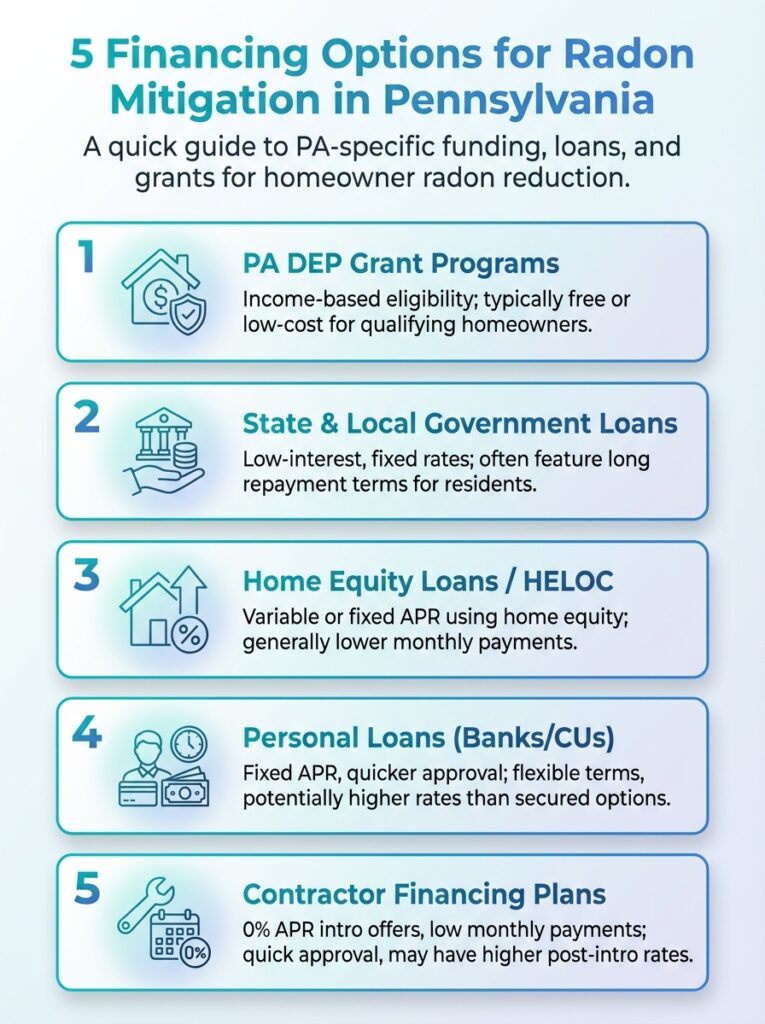
This infographic highlights five financing options for radon mitigation in Pennsylvania. It helps homeowners compare funding choices and understand available programs.
4. Five Common Financing Options For Radon Mitigation In Pennsylvania
Different homes and budgets call for different ways to pay, so we often walk Pennsylvania homeowners through multiple choices. You can mix and match these options depending on your situation and comfort level with loans or credit.
4.1 Installer-Backed Financing Programs
Installer-backed financing is often the easiest because everything runs through the contractor. We provide cost, term, and monthly payment figures in one place so you do not have to shop separately for a lender.
4.2 Home Equity or HELOC
Some homeowners in Pennsylvania prefer to use a home equity line or loan when making several improvements at once. This can be cost effective if you already plan to borrow against equity for other work.
4.3 Personal Loans and Credit Cards
For smaller jobs around $800 to $1,500, a personal loan or low-interest credit card can be enough. The key is to check total interest cost and compare it to installer-backed terms.
4.4 Real Estate Transaction Credits
In many sales, buyers and sellers split mitigation costs using seller credits at closing. We often coordinate with real estate agents so mitigation is scheduled as soon as you take ownership and you still have the option of financing any remaining portion.
Did You Know?
Permanent radon mitigation systems in Pennsylvania typically cost between $800 and $1,200, with many jobs ranging from about $500 to $2,000 and complex projects sometimes exceeding $4,000, which is why flexible financing is so helpful for homeowners.
5. Financing And Radon Levels: Why Zone 1 Areas Often Need A Budget
Many of the communities we serve, including Germansville, Lynnport, New Tripoli, and Slatedale, sit in EPA Zone 1, which is the highest radon potential category. Lehigh County data shows a large share of homes above the action level, and we have personally seen readings over 20 pCi/L in everyday houses.
When so many homes in a region routinely test high, the odds increase that you will eventually need to fund mitigation. A realistic financing plan lets you treat radon mitigation like any other long-term upgrade instead of an emergency that strains savings.
In practice, that means including a radon line in your home maintenance budget, even if you have not yet tested. Once your results are in, you can adjust the budget up or down based on what type of system your home requires.
6. Budgeting Example: From Radon Test To Monthly Payment
To make the numbers more concrete, here is how a typical Pennsylvania homeowner might budget from first test to financed mitigation. We will assume a standard single-family home in Lehigh County.
- Initial testing: DIY kit around $20–$30 or professional test around $150.
- Results over 4 pCi/L: We design a sub-slab depressurization system and quote $1,600 for a standard installation.
- Financing choice: 24-month plan at 0% APR would be roughly $67 per month, depending on exact terms and taxes.
- Installation: Work is scheduled promptly, payment is handled monthly through the financing provider.
Many homeowners tell us that turning an unplanned $1,600 bill into around $60–$80 per month makes the decision much easier. You always see the total cost upfront, and we clearly explain any term or fee before you sign.
7. Finding Qualified Radon Pros In Pennsylvania Who Offer Financing
Financing only helps if the installer designs an effective system and stands behind the work. We always encourage homeowners to look for certified professionals with clear warranties, transparent pricing, and experience in Pennsylvania’s specific geology.
You can use national and regional directories to confirm credentials and find local providers:
- Radon PDS “Find a Pro” tool for certified installers.
- Radon.com Find a Professional directory.
- Certified Radon Pros national listing with verification.
- Certified Radon Pros Pennsylvania page for PA-specific providers.
When you contact a company, ask directly about financing options, warranties on fans and systems, and whether post-mitigation testing is included in the price. We include follow-up testing and support so you can confirm that your investment is working as intended.

Did You Know?
All 67 Pennsylvania counties have documented radon exposure, and statewide averages are high enough that many homeowners eventually face mitigation costs and look for financing to handle them smoothly.
8. Local Financing Considerations In Lehigh County And Nearby Towns
Financing details can vary slightly by county and lender, but some patterns are consistent in Lehigh County and surrounding areas. In high-radon zones such as Germansville, Bethlehem, and Allentown, lenders and real estate professionals are already familiar with radon as a routine line item in transactions.
Here are a few local points we see often:
- Buyers in towns like New Tripoli and Lynnport often request radon testing during inspections.
- Sellers may agree to provide a credit instead of installing a system themselves.
- Some appraisers and underwriters expect documentation of mitigation when readings have been high.
We are used to coordinating schedules with agents, title companies, and underwriters so that mitigation and financing fit smoothly into your closing timeline. Clear documentation of system design and test results helps everyone involved.
9. Comparing Cash Payment Versus Financing For Your Situation
Some Pennsylvania homeowners prefer to pay cash and be done with it, while others like the predictability of a monthly payment. Both approaches work, and we help you compare options without pressure.
| Approach | Pros | Cons |
|---|---|---|
| Pay cash in full | No ongoing payments, no financing paperwork, potentially lower total cost if you avoid any interest | Larger upfront hit to savings, may delay installation if you need time to save |
| Use 0% APR financing | Smaller, predictable monthly payments, preserves emergency savings for other needs | Requires application and approval, promotional terms may be time limited |
| Blend cash + short-term financing | Lower financed amount, manageable payments, flexibility to pay off early | Still requires some upfront cash and attention to lender terms |
We recommend reviewing your overall budget, upcoming expenses, and how quickly you want installation completed. Then we provide clear numbers for each option so you can decide what fits your household best.
10. Questions To Ask Before You Sign Any Radon Financing Agreement
Before you commit to any financing, we encourage you to treat it like any other household financial decision. Asking a few clear questions up front can save you from surprises later.
- What is the total project price, including tax and permits?
- Is the financing 0% APR for the entire term or only as a promotion?
- Are there any origination fees or prepayment penalties?
- What is the warranty on the radon fan and system components?
- Does the price include post-mitigation testing and follow-up support?
We answer these questions in writing for our customers so everything is clear from day one. That way, your focus can remain on choosing the right installation approach rather than worrying about the fine print.
11. Long-Term Value Of A Professionally Financed Radon Mitigation System
When you finance a radon system, you are not only covering a contractor bill. You are funding a permanent improvement to the way your house interacts with the ground and air beneath it.
In Pennsylvania, buyers increasingly expect radon testing and often prefer homes with existing mitigation systems. A professionally installed and documented system can be a selling point later, especially in EPA Zone 1 zip codes.
We design systems with longevity in mind, including correctly sized fans, thoughtful pipe routing, and clear labeling. Spread over several years, the monthly cost often feels modest compared to the long service life and peace of mind that a good system provides.
Conclusion
Radon mitigation financing in Pennsylvania is less about complicated loan structures and more about giving you practical ways to handle a necessary home upgrade. With typical systems running from about $800 to $2,500+, financing can turn an unexpected expense into a manageable monthly line item.
As a local mitigation provider, we are here to help you understand your test results, design the right system, and choose payment options that match your budget and timeline. If you live in a Pennsylvania community with elevated radon levels and have questions about cost or financing, we are ready to walk through the numbers with you step by step.